The Lie of the Strong Man
The strongman always arrives at the same moment: when patience runs out and faith in rules runs thin.

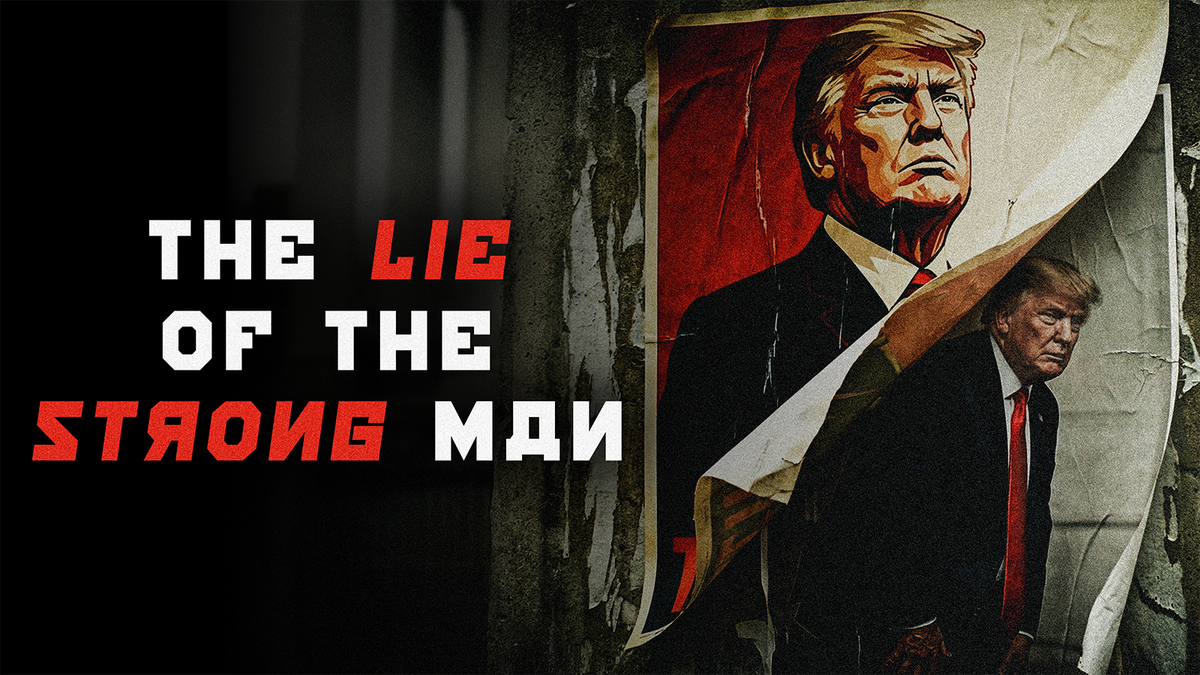
"Hard times create strong men. Strong men create good times. Good times create weak men. And weak men create hard times."
- G. Michael Hopf, Those Who Remain
The most revealing thing Donald Trump has said in the opening days in 2026 wasn't about oil, tariffs, or even the particular thrill he seems to get from treating geopolitics like a game. It was a doctrine.
In a New York Times interview, Trump was asked what limits his power. His answer wasn't Congress, courts, treaties, alliances, or the laws the United States helped write after World War II. It was...himself. His "own morality." And then he said: "I don't need international law."
After a decade of deep public glimpses into the man's psyche, it's not a particularly shocking statement coming from him. We know he's a narcissist. We know he's insecure. And we know he has a seemingly pathological need for constant praise and dominance of every news cycle.
What it does reveal, however, is an administration that is increasingly getting comfortable with saying the quiet part out loud: the rules are optional, and the only real check on power is the person holding it.
Which is exactly what the post-World War II rules-based international order was built to prevent.
Strength vs. "Strength"
There's a line you've probably seen a hundred times online:
"Hard times create strong men. Strong men create good times. Good times create weak men. And weak men create hard times."
The quote sounds like it's a piece of ancient wisdom, but it actually comes from a post-apocalyptic novel by G. Michael Hopf. A little on-the-nose for this moment.
But there's a reason it's memorable. It expresses a truth people can feel. Something is decaying and people do feel it. They can sense that the "normal" they were promised was either a lie or just brittle. They're watching stalwart institutions crumble. Trust in the system is almost non-existent. The "strong man" may be a bloviating buffoon; but at least the lies he tells us promise a return to prosperity, right? Meanwhile a feckless establishment seems wholly unprepared for this moment; stuck in the old political strategies that favor competent governance over feel-good spectacle optimized for the attention economy.
But the quote blurs two very different kinds of strength.
A strong man is someone capable of restraint. Someone who can accept limits without interpreting them as humiliation. Someone who can keep promises, tell the truth when it costs them, doesn't resort to cruelty, and has the intestinal fortitude to do the right thing when no one is watching (or clapping).
A strongman is the opposite; a vapid performer of dominance. He speaks in the language of strength – swagger, threats, and spectacle – because he's terrified of looking weak. He wages war against reality because under the facade, he's deeply afraid of humiliation, loss, and feeling ordinary. Strongmen don't want constraints because constraints imply they're not the main character in their story. So they rely on spectacle to mask their weakness.
A society that can't tell the difference between the two ends up relearning the lesson the hard way. The lesson is that restraint is not weakness. It's the whole point.
The Test Case
On January 3rd, 2026, U.S. forces raided Caracas, Venezuela and captured Nicolás Maduro and his wife, Cilia Flores, removing them to the United States to face charges. Trump then announced that the U.S. would "run the country" until some future "transition" took place.
Maduro was a dictator. He wasn't a good person. You can believe that he needed to be ousted. You can believe the world is better off without him.
But...if the question is whether this is a return to "strength," you have to ask the hard questions:
By what legal authority does a country seize another country's head of state? Who decides what "transition" actually means? If the U.S. is now engaging in this kind of behavior, what happens when other powers copy the precedent? What happens to global stability when the most powerful country on Earth returns to a mindset of conquest and governing other countries directly, as a matter of executive will?
And it doesn't stop at Venezuela. Axios mapped an expanding list of countries the "no new wars" president and his surrogates have threatened with military action or territorial claims. At last count, there were eleven countries on the list. There are various pretexts for the threats, from anti-cartel rhetoric to simple hemispheric entitlement. But the common denominator for all of them is that the United States' new diplomatic policy is intimidation and force.
Greenland is the clearest example of why this moment is not normal. It should snap people awake to the reality of the situation.
Greenland is a self-governing territory within the Kingdom of Denmark. They've explicitly rejected a U.S. takeover and emphasized that its defense should be handled through NATO. To be clear: attempting to conquer a NATO ally would be the end of NATO.
Let that sink in. An American president's territorial appetites are being discussed not as some absurd hypothetical, but as a real scenario serious enough to end the most important alliance on the planet. It would teach every other country that the law is irrelevant and power is the only thing that matters.
So at some point the question becomes...unavoidable. Why are we pretending we're still living inside the old rulebook?
The Invisible Luxury of the Rules-Based Order
Most Americans alive today have lived in a pretty weird bubble, historically speaking.
It hasn't been perfect or morally pure. It's been laden with instances of hypocrisy where the U.S. violated its own professed ideals.
But broadly speaking, the post-World War II alliances, treaties, predictable norms, and shared international law helped keep the world relatively peaceful. Of course we still had wars, but this order greatly reduced the incentive for world powers to solve disputes with each other using direct force. It made the world more predictable, less suicidal, and – most importantly – it lowered the temperature in the nuclear age.
That stability has become a sort of invisible luxury that just works and most people don't really need to worry about.
The problem with invisible luxuries, though, is that the people who inherit them start to treat them as laws of nature. They tend to assume that the cost of maintaining them is zero and the cost of breaking them is imaginary. They never had to personally watch a car go off the geopolitical cliff, so they don't really remember why the guardrails exist there in the first place.
The World War II generation did. They lived through depression, total war, and deep national trauma. They were shaped by hard times and subsequently built a system designed for moments when countries are angry, scared, humiliated, and tempted. They understood that rules aren't there for when everyone is calm. Rules are there for the exact moment when everyone isn't.
But...the longer you go without catastrophe, the more catastrophe starts to feel like propaganda. Constraints start to look like unnecessary obstacles, international law starts to look like smug academia, and alliances start to look like charity.
So then a strongman shows up and says "I can get rid of those obstacles. I can make the world simple again. I can give you revenge. Just give me the wheel."
And a public that's been primed to distrust every political establishment hears that as strength, instead of what it actually is: the offer of autocracy wrapped in emotional satisfaction.
Weakness
When people hear "weak men," they imagine spoiled trust-fund kids, nepo-babies, out-of-touch elites, and people who have never known struggle. Sometimes that's part of it.
But the more dangerous weakness is both moral and psychological instead of economic.
Weakness looks like treating politics like sports because you don't think its impacts will ever actually show up at your own door.
Weakness looks like trading your courage for cruelty because it's easier to attack others than it is to withstand attacks against yourself.
Weakness looks like cheering lawlessness because it feels like revenge against a system you think is broken beyond repair.
Strongmen sell this as some kind of liberation. They defy the law because they're "outsiders," they rail against expertise and call it "conspiracy" from academic elites, and they claim accountable governance is little more than "weakness."
And because he's little more than a performer, he escalates, creates outrage, and causes crisis after crisis; then touts those same crises he inflames as proof that only he can fix them.
The Insidious Creep of Nihilism
If you're a Millennial or older, you grew up in a time where politics were largely boring. So we look at Donald Trump and the MAGA movement and see an aberration.
But Gen Z?
They grew up with permanent crisis. Financial instability, pandemic, outrage economy, institutional distrust, and the chaos of Donald Trump have always been there for them.
Many of them don't experience the "rules-based order" as safety. Instead they experience it as a set of rules that have protected somebody else's wealth. Meanwhile they watch housing grow increasingly out of reach and are deeply concerned (certainly not without good reason) that AI will further destroy their hopes of achieving any sort of American Dream.
Nihilism isn't just feeling like things are bad. It's believing that nothing is real, nothing will improve, and nothing deserves protection. Once that mindset takes hold, the idea of protecting the system in place just sounds like protecting the people who own the system.
That's why saying "the rules kept you safe" doesn't really resonate. They don't feel safe.
So when a strongman says "f**k the rules," he sounds like someone finally angry on their behalf. Even when he's only using that anger to concentrate power, enrich himself and his allies, and make the world more violent and less predictable.
Where Are We?
It's hard to overstate how precarious this moment is. Anyone who pretends to know exactly how it ends is either lying to themselves or to you. There are just too many variables. Domestic institutions, global rivals, economic shocks, tech disruption, the sheer chaos of decision-making built around one man's impulses.
But I think the overall shape of the problem is clear.
We're watching a deliberate and concerted effort to replace liberal democracy with conservative autocracy; international law bucked in favor of "my morality;" alliances based on leverage rather than multilateralism.
We're watching a morally weak strongman, spoiled by the prosperity given to us by the greatest generation, attempt to lead us into hard times. And we're watching a public that is exhausted, disaffected, and algorithmically primed to mistake domination and cruelty for competence.
Despite all that, though – I can't help but feel a genuine sliver of hope.
A hope that this illiberal shift is so sudden, so extreme, and so incompetent (as bloviating strongmen tend to be) that it shocks the general public awake.
A hope that these hard times mobilize the American people to find their strength.
And a hope that through this newfound strength, we are able to bring about a new age of goodness and prosperity. Economically, culturally, and – most importantly – with a renewed faith in the national identity that made America the "shining city on the hill." The national identity that inscribed these words on the Statue of Liberty:
Give me your tired, your poor,
Your huddled masses yearning to breathe free,
The wretched refuse of your teeming shore.
Send these, the homeless, tempest-tost to me,
I lift my lamp beside the golden door!
- Emma Lazarus, The New Colossus, inscribed on the Statue of Liberty

Thank you so much for reading! If you enjoy my work and want to support me further, one-time tips are always appreciated but never expected.