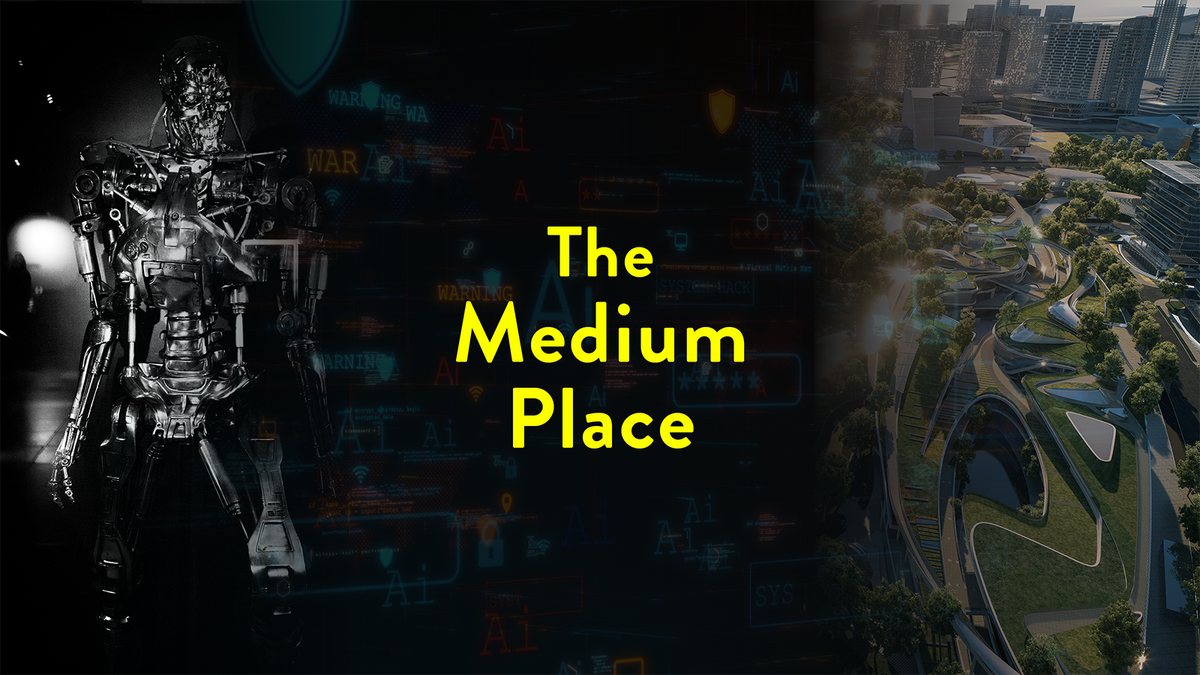
The Medium Place: If AI Doesn't Kill Us All
AGI might not kill us, but it probably won’t save us either. The more likely future is a dreadfully average world that’s neither hell nor utopia; just a comfortable cage run by a new aristocracy.

Let's assume we finally achieve AGI (artificial general intelligence); that is, artificial intelligence that is at least on par with human cognitive capability. AI researchers Daniel Kokotajlo, Eli Lifland, Thomas Larsen, and Romeo Dean wrote a speculative but detailed scenario about the rapid advances they expect from artificial intelligence in the coming years. Neither of their potential outcomes are particularly rosy; in fact, one predicts the (thankfully quick and maybe painless) death of all humanity. For the sake of this article, however, let's be optimistic and assume that the AI doesn't kill us all.
If AI indeed doesn't kill us, you might be inclined to assume that superhuman intelligence will finally bring about the utopian society that humanity has always dreamed of: infinite abundance; no one has to work; you spend your days lounging beachside while robots do your dishes, fold your laundry, and cook you Michelin-star meals every evening.
Death/abundance via AI are the binary feel-good/feel-bad movie endings.
My bet? We don't get either.
If (or when) AI really does get good enough to replace most human labor, my opinion is that the most likely future looks a lot more boring and a lot more familiar. I predict a return to feudalism where a global aristocracy lives inside something that's pretty close to true utopia, while everyone else exists in some form of reality that's not quite hell but certainly not heaven.
The medium place.
What the "Medium Place" Actually Is
It's comfy enough to function, but just irritating enough to make sure you're never at ease.
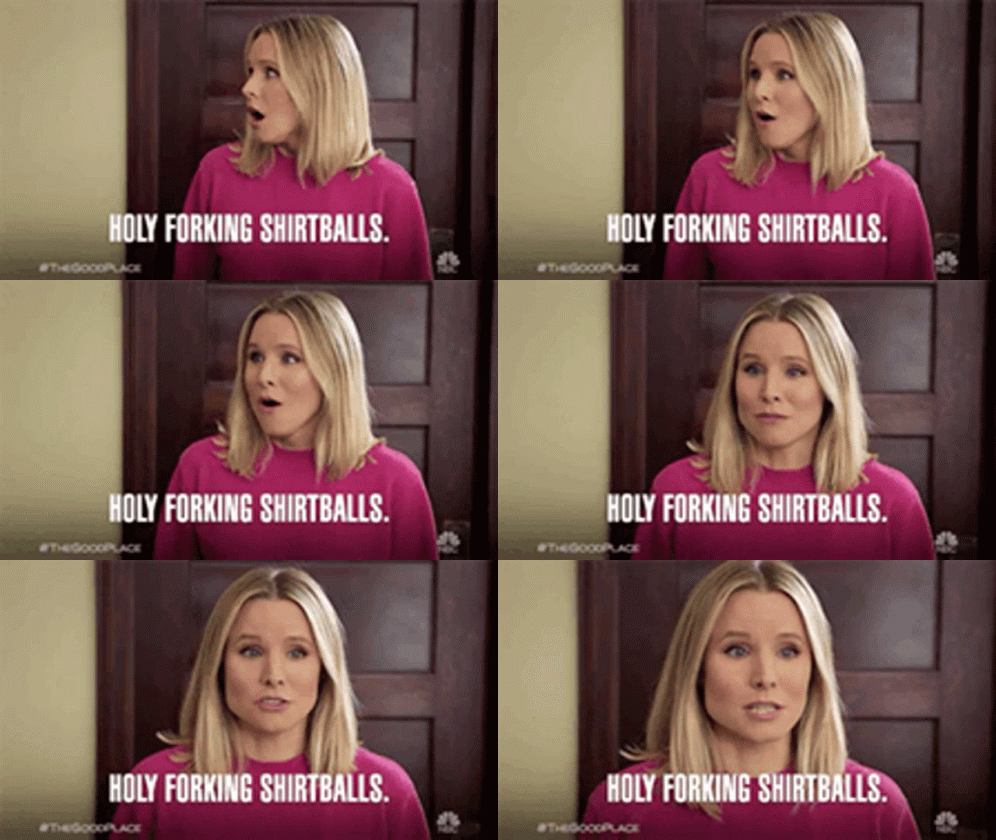
If you've watched The Good Place (and if you haven't, you really need to. It's an amazing show), you know the bit: The Good Place and Bad place couldn’t decide if Mindy St. Claire deserved utopia or literal hell, so they compromised on a new realm called the "Medium Place." It's not terrible, but it's not good. There's no outright sadness, but there's certainly no happiness. It's comfy enough to function, but just irritating enough to make sure you're never at ease.
Now apply that to AI.
In my medium-place future, AI and robotics really do replace most human labor. Factories, logistics, customer service, legal research, software, design, blue collar jobs, and maybe even politics get automated into something that looks magical. Rather than economic productivity going up by a modest 20% it goes up by many orders of magnitude.
But with humans being humans, we know that new wealth won't fall from the sky evenly. Instead it will flow through pipes we've already built. Giant platforms, concentrated capital, captured states. Whoever owns the models, data centers, supply chains, and distribution networks own the future. I've mentioned neofeudalism before; AGI in the hands of a small few brings us to that future instead of just a nicer version of capitalism.
In this scenario, you don't really need a broad middle class to buy things anymore. You don't even necessarily need the economy to grow for everyone. The new "nobles" can point their AI factories at themselves: AI produces luxury goods and services for the elite, AI optimizes their portfolios, AI designs their cities and drugs and private security bubbles. And the rest of society gets just enough to stay pacified and out of the way.
That's basically the core of the Medium Place scenario: post-labor capitalism without post-scarcity politics. AI may wipe out the need for most human work, but the people who own the AI keep almost all of the upside.
Life at the Top, Life at the Bottom
"career" starts to mean gig work that involves serving a member of the new aristocracy so that they can look wealthy and powerful to their friends.
Let's explore a day in this world!
At the very top, you have the AI aristocracy. Some are founders. Some are investors. Some are heirs who were born lucky enough to own and inherit the good life.
Their lives are absurd.
Medicine is personalized and predictive. Their kids get tutors, whether human or machine, that put today's best schools to shame. Their homes are smart in the way "smart home" marketing never lived up to. The building learns their preferences, adjusts, notices early signs of illness, summons drones and staff before they even ask.
Human staff, by the way.
Because here's the fun twist. Hiring people actually becomes a status symbol in a post-AGI aristocracy. When your personal AI can handle cooking, cleaning, scheduling, security, and childcare, paying actual humans to do it anyway is the new flex. As in the feudal courts of old, owning someone's time is part of what proves that you're an individual of high status.
So the aristocracy keeps small armies of bartenders, nannies, drivers, chefs, stylists, tutors, groundskeepers. Not because they need them. Because they can.
For everyone outside that bubble, life is...fine. Kind of.
You get some version of Universal Basic Income (UBI). Your stipend covers modest housing, food, basic necessities and decent options for staying entertained. You get access to AI tools that help with schoolwork, therapy, entertainment, maybe even personalized career coaching – although "career" starts to mean gig work that involves serving a member of the new aristocracy so that they can look wealthy and powerful to their friends.
If you want to bump up your income a bit, you can pick up some of the aforementioned gig work. You might tend bar, work events, help maintain the systems that keep the aristocracy's abundant playgrounds humming. But those jobs are precarious by design, and they rarely, if ever, seem to let you stack enough money or influence to actually join the owner class yourself.
Your days are full of screens and simulations. VR worlds cheaper and more vivid than any vacation your grandparents ever dreamed of. Games that adapt to your psyche in real time and feeds tuned to your emotions better than you can tune them yourself. With some restrictions, of course. The aristocracy needs to make sure your emotions don't lead you to deciding that you someday want real freedom like theirs.
So you're not starving. You're not in a camp. You have enough to get by and you're even allowed to complain, to an extent.
You're just...contained.
The New (Feudal) Deal
No one needs to preemptively march you into a re-education camp. You learn the boundaries instinctively.
So what, exactly, keeps this arrangement stable? Quite simply, it's the same thing that kept things the same way for much of human history.
Old-school feudalism rested on a pretty simple bargain: the lord protects you from chaos and starvation. And in return, you accept your place and send tribute upward.
The Medium Place runs on a similar deal, just modernized for the post-AGI era:
Protection
No mass unemployment riots. No food lines. No one "stealing our jobs", and no discriminatory pay gaps with stipends. Your UBI always hits on time and the lights stay on. Law enforcement is managed by predictive policing, mass surveillance, and swarms of drone "beat cops" that can quickly detect and interdict crimes. Disasters are handled by drone fleets where possible. The "basic ground" of your life is incredibly stable.
Distraction
In addition to religion (religion in the post-AGI world deserves its own book; I think a massive grassroots resurgence of organized religion is incredibly likely in this world; I won't dive into it here, but if you're interested in a deep-dive about that, send me an email and I'm happy to prioritize it!) and your social circle, you get personalized feeds, virtual worlds, and endless parasocial relationships. The system can read your mood from biometrics and micro-gestures, then push you toward whatever will keep you both online and calm. And, of course, everything you interact with will be advertising to you as well. Marketing can never die.
Hope Tokens
Lotteries, talent shows, creator-economy success stories, and various other contests allow a tiny fraction of people to escape into the aristocracy (or at least be adjacent to it). Their stories are featured everywhere. They're the proof the system uses to argue that "anyone" can make it, even though it's hardly true. It sounds kind of like The Hunger Games, right? Except here you don't have to die when you win the lottery. Yay!
Surveillance and "Safety"
The mass surveillance I mentioned earlier uses sophisticated filters that ingest a firehose of data: every transaction you make, every message you send, and every digital (or even physical) step you take. These filters scan for risk. It's all framed as security like fraud detection, harm reduction, counter-terrorism, community health, and so on. Your social credit score isn't necessarily branded as such, but you know you can lose access to platforms – and thus to money from gig work, food from your favorite restaurants, and your social life – if you accidentally trip the wrong wires.
No one needs to preemptively march you into a re-education camp. You learn the boundaries instinctively. You internalize what's "safe" to say or search or share, because the penalties for stepping outside the lines show up as tiny, stacking frictions. Slower responses, closed accounts, fewer housing options, mysteriously denied travel permits; basically getting shadow-banned from real life. And, of course, you've heard stories about what happens to the people who stepped too far out of line – the ones who mysteriously took an international trip and maybe disappeared from your social (or parasocial, if maybe they were an influencer you liked) circle and are rarely heard from, save for the occasional "hey, I'm still around!" post.
Powerful elites + algorithmic surveillance + UBI + infinite distraction are the basis for the ultimate form of social control.
Why It Feels "Medium" Instead of Horrific
And that's what makes the Medium Place so dangerous. It's dystopia that's not-so-subtly telling you that things always be a lot worse; and that if you don't like it, we'll show you just how much worse they can really be.
If you're like me, imagining everything up until this point sounds terrible. You might be inclined to think "there's no way I'd ever accept that life." But I've unfortunately got a bit of bad news for you, because some pieces of this are already here.
- We already trade privacy for convenience every time we accept yet another Terms of Service agreement that lets trillion-dollar companies build and sell our digital profiles to parties who see us as nothing more than potential revenue.
- We let engagement algorithms decide what exactly counts as "speech that matters" because all the social media companies are doing it anyway and that's where the people are.
- We accept workplace monitoring software because the rent is due and the job market sucks.
- We become desensitized to suffering as we scroll past wars and tragedies in feeds that are engineered to make a skincare ad feels like respite from an ever-worsening world.
By the time we realize we're firmly in the aforementioned reality, we've already taken a thousand small steps toward it. Each step a compromise. Every inch forward a little worse than the last; but it doesn't feel terrible compared to the last one, right? We're all just trying to make it through life, and fighting a system that's not built with you as the intended beneficiary anyway makes you ask "why even bother fighting it?" And so the Medium Place, rather than being a hard break into a new reality, is merely a continuation: our existing reality just pushed to its logical extreme once AI can do most of the productive work that was once the sole domain of human beings.
Because it arrives so gradually, it doesn't quite feel like dystopia for most people most of the time. Whatever enforcement apparatus exists doesn't make you fear for your life with every action you take, but you quietly learn not to search certain topics. You decide not to join that group chat. Not to go to that protest because, hey, you don't want to invite trouble into your good-enough life.
Materially speaking, your life might even feel a lot better than your parents' or grandparents' in some ways. In fairness there's less grinding work, fantastic healthcare, cheap entertainment, and few, if any, existential money crises. The sky is still blue and soccer practice still happens.
And that's what makes the Medium Place so dangerous. It's dystopia that's not-so-subtly telling you that things always be a lot worse; and that if you don't like it, we'll show you just how much worse they can really be. Because if the boot is never fully on your neck, rather just hovering nearby, it takes a different kind of courage to say, "This isn't good enough."
Freedom as UX vs. Freedom as Power
You're free the way a user is free inside of an app on a phone. The sandbox has plenty of options inside of it. But you get absolutely no control over the sandbox itself.
The heart of the Medium Place problem is a mismatch between two senses of "freedom."
On the surface, it seems like you're more free than at any point in human history. After all, you can sit around and binge all the content you could ever want, you can escape into immersive virtual worlds, and you don't even have to work a day in your life if you really don't want to. Like any good tech product, you get a beautiful interface. The UX ("user experience") of your daily life is super smooth. But underneath the pretty veneer your actual power is increasingly diminished.
You have exactly zero ownership over the platforms that you're forced to rely on. You don't get any actual say in the way that the AI models running your life get trained or deployed.
You're free the way a user is free inside of an app on a phone. The sandbox has plenty of options inside of it. But you get absolutely no control over the sandbox itself.
We already feel that tension in our online existence today. Imagine if it were scaled up to the level of your entire existence.
The AI-Powered Aristocracy
...the balance of power will shift so far upward that most people will end up in a position of dependence.
You might ask, "why does AGI have to lead to neofeudalism and aristocracy? It's because it collapses the gap between labor and capital.
In the classical version of capitalism, workers were its lifeblood. You could organize, strike, vote, and bargain because owners needed the time and bodies of laborers to actually make things.
But in the post-AGI Medium Place, however, capital is the worker. Once a handful of AI models can perform most economically useful tasks, whoever controls them has leverage over literally everything else. Because how does one strike against a datacenter? How can you unionize against an AI model?
Researchers have already begun to sound the alarm about this exact pattern. The more "general" AI becomes, the more bargaining chips will begin to shift to the handful of people who actually own and govern the infrastructure that AI lives on.
Human labor won't necessarily just vanish in this potential future. High-skill niches will still exist, as well as low-status service labor. But the balance of power will shift so far upward that most people will end up in a position of dependence. They'll wait for their regularly scheduled allocations of money from a governing body they have no real say in and access to systems they neither understand or control.
That's what makes this scenario of technofeudalism feel so depressingly apt. It's simply a return to a period in human history where lords rule over the peasants, except now the peasants aren't actually needed anymore.
Why UBI Alone Won't Save Us
You're "taken care of," in the way that farm animals are taken care of. Fed, stabled, tagged, and watched.
Whenever discussions about the post-AGI future come up, most peoples' first reflexive instinct is to say, "That's why we need Universal Basic income!"
They're not wrong. There's just more to it. Some guaranteed baseline of human dignity will be an absolute necessity in a world where essentially all human productivity has been destroyed by AI. The problem is treating UBI like it's a cure rather than a band-aid for a much deeper kind of dysfunction in human society. Because in the Medium Place, UBI just acts as a tranquilizer instead of a bridge. Instead of abundance for all of us, it will instead be used as a way to keep the masses pacified while the fortunate few enjoy the closest thing to utopia we've ever seen. It's an unholy amalgamation of the worst parts of both socialism and capitalism.
Safety nets and your stipend help to keep you out of destitution, but they don't give you any leverage over the people who actually own the machines. They don't let you buy any tangible amount of shares in the platforms that govern your life, and they certainly don't give you a vote in how surveillance is run or how AI systems are deployed. They're meant to lock in dependence. You live off a payment managed by the same corporate state that set up the new technofeudal order in the first place. You're "taken care of," in the way that farm animals are taken care of. Fed, stabled, tagged, and watched.
When, not if, the terms of that arrangement shift, your ability to resist the system will be increasingly limited by design. "Safety" requirements will expand. "Misinformation" will be defined ever more broadly. Weaknesses in the system will be treated like software bugs and patched to make the guardrails ever stronger.
Is the Medium Place Inevitable?
We need to place our thumbs on the scale, because if we don't, there is no good outcome for the masses when AGI is plugged in to our current sociopolitical economy.
Is this just doomposting? Am I selling the same kind of (cope/hope)-ium that the AI evangelists and doomers are hocking? The truth is that I really don't know.
My take here is based on what I've observed as a student of human history. We've made incredible gains in material abundance for the common person in the modern world, but the one thing that has remained the same is the zero-sum game played by power brokers and influence peddlers. Greed is a natural instinct for humans, and I hate the game rather than the player here. For hundreds of thousands of years, humans have managed scarcity. It's not farfetched that we'd play the same game in a post-AGI world of true material abundance. That those with the most power and influence would fight to cement their own power for fear of losing it to someone else rather than for some callous cartoon-villain goal of ruling over everyone else.
I don't think that the Medium Place is our only option. But I also don't think that we can just let things play out as they may and hope for the best. We need to place our thumbs on the scale, because if we don't, there is no good outcome for the masses when AGI is plugged in to our current sociopolitical economy.
If we don't want this dystopia, we have work ahead of us that's harder and less glamorous than talking to chatbots. We need to fight over who owns and who governs the system.
That involves boring work like building legal frameworks that treat AI models like utilities instead of toys to be deployed at the whims of private enterprise. It means aggressively regulating firms that aim to own the entirety of everyday human life. Humanity at large needs to have a genuine say over how AI is deployed across our world. We have to insist that the abundance generated by AI comes in the form of more homes, more energy, and more infrastructure for all of society instead of our historical dichotomies. There will likely always be an upper-class and lower-class, but in a post-AGI world there's no reason that gap can't be narrowed significantly.
It also means pushing ourselves to imagine scenarios deeper than the simplistic binary of "killer robot apocalypse" vs. "perfect utopia," because if those are the only futures we let ourselves entertain, the Medium Place will remain an invisible force that slowly metastasizes itself into reality.
Whether you like AI or not (and to be honest, I really don't. I'm the mouse angrily yelling, "who moved my cheese?!"), the reality is that AI can and will do incredible things. The fight needs to be over whether most of us will live as full participants in that future or if we'll just be well-entertained NPCs in someone else's utopia.
The Medium Place is what we get if we let the current top of the pyramid plug a godlike tool into the status quo and call it a day.
We don't have to accept that. But refusing it requires something uncomfortable. It requires looking at lives that are "not that bad" and saying, out loud, "This isn't freedom. This isn't enough."

Thank you so much for reading! If you enjoy my work and want to support me further, one-time tips are always appreciated but never expected.