The Racket Never Dies
Ninety-one years ago today, on February 17th, 1935, Smedley Butler took to WCAU radio in Philadelphia and told the American public what Congress wouldn’t.

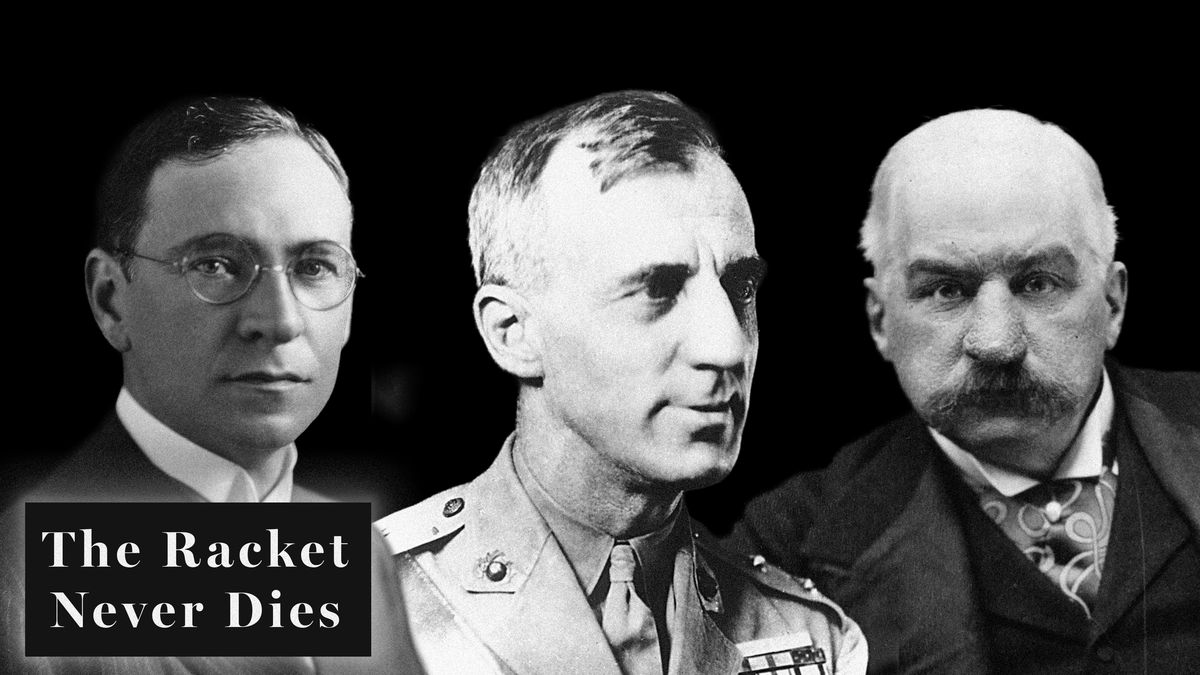
"I was a racketeer for capitalism."
This quote was a confession from one of the most decorated Marines in American history, describing thirty-three years and four months of service. He helped make Mexico safe for American oil interests. He purified Nicaragua for the international banking house of Brown Brothers. He brought “light” to the Dominican Republic for American sugar barons. One time he said, “I might have given Al Capone a few hints. The best he could do was operate his racket in three city districts. We Marines operated on three continents.”
He also gave us a definition. “A racket is best described, I believe, as something that is not what it seems to the majority of people. Only a small inside group know what it is about. It is conducted for the benefit of the very few at the expense of the masses.”
Now read the Washington Post’s investigation of DOGE. The man who led “government efficiency” received at least $38 billion in government contracts, loans, subsidies, and tax credits. He spent $277 million to help elect the president who appointed him. A sitting Supreme Court justice asked from the bench whether this constitutes quid pro quo.
Sound similar?
Butler’s framework is nearly a century old now. And it’s never been more precise.
How the Racket Works
The racket is the mechanism. Private extraction is disguised as “public service.” Butler saw it in imperial wars sold as “spreading democracy.” The 1930s financiers of the Business Plot dressed it as “saving the country from communism.” DOGE dressed it as “government efficiency.” The costume changes over the decades, but the structure itself always stays the same. It’s just public rhetoric masking private enrichment.
The racket’s sustainability relies on the sheer impunity of its conspirators. Without impunity, all you have is a scandal or crime that gets prosecuted. With it, the racket is a business model that scales across American generations.
The test case for the racket arrived in 1934. Wall Street financiers — backers from DuPont, J.P. Morgan, and General Motors among them — plotted to overthrow President Franklin Roosevelt using a 500,000-man veterans’ army modeled on Mussolini’s March on Rome. They claimed $300 million in available backing (about $7 billion or so today). They recruited Butler to lead it. By that point, Butler has spent decades overthrowing governments on behalf of some of the same bankers.
General Smedley Butler blew the whistle.
Congress investigated. The McCormack-Dickstein Committee confirmed it: “There is no question that these attempts were discussed, were planned, and might have been placed in execution.” They collected 4,300 pages of testimony across six cities. The New York Times called it “a gigantic hoax” two days into testimony. This was while committee staff were still digging up bank records that verified Butler’s account.
Yeah…the renowned New York Times declared the whole thing fake before the investigation was even finished.
And then: zero prosecutions. The names of the powerful conspirators were removed from the public report. Butler responded, “Like most committees, it has slaughtered the little and allowed the big to escape. The big shots weren’t even called to testify.”
The lesson was learned and the message was heard loud and clear.
The Impunity Stations
Iran-Contra: 1985-1987; pardons 1992
Senior officials of the Ronald Reagan administration ran a secret, illegal war. They funneled money through Swiss accounts for illegal arms sales to Iran and funding Nicaraguan rebels. In direct violation of congressional law. Fourteen were charged, but only one served prison time. The rest were pardoned by George H.W. Bush.
The same George H.W. Bush whose own father, Prescott Bush, had his assets seized under the Trading with the Enemy Act for banking relationships with Nazi-era industrialists. The same George H.W. Bush who later received a $1.5 million windfall when those assets were returned, and later went on to become a United States senator.
Note: to be clear, Prescott Bush’s specific role in the Business Plot is historically contested. His “Trading with the Enemy Act” violations, however, are well documented.
The Iran-Contra personnel didn’t just escape the consequences of their actions, though. They came back to the seats of power. Elliott Abrams, Bill Barr, and John Bolton all served in the Trump administration. As TIME reported, “The rule-breaking and impunity during Iran-Contra may have set the stage for Trump.”
2008 Financial Crisis
The largest financial fraud in American history produced zero criminal prosecutions of Wall Street executives. Eric Holder said it plainly: banks had become “Too Big to Jail”. The savings and loan crisis of the 1980s (a much smaller catastrophe by comparison) produced over 1,000 convictions. 2008 sent the same signal as the Business Plot: the consequences aren’t coming.
Obama on CIA Torture
“Look forward, not backward.” The impunity system is bipartisan. It has to be. Power protects power regardless of party. The Republican Party has become openly fascist particularly during the second Trump term, but historically the powers that be were united by just that: power.
Sacrificial Lambs
Now, accountability does arrive sometimes. Enron produced twenty-two convictions. Madoff got 150 years. Sam Bankman-Fried is doing twenty-five. But notice who gets held accountable: the ones who have become politically expendable. Executives who were already toxic, Ponzi schemers who robbed the rich, and crypto bros who lacked political patrons. The racket isn’t that no one ever gets punished, it’s that punishment is selective. And the selection criteria revolves around political protection rather than guilt.
Mask Off
Every previous version of this played out with at least the fiction of accountability still intact. Pardons acknowledged that something worth pardoning had occurred. Non-prosecutions got framed as difficult legal judgments. Someone, somewhere, at least pretended to care.
So what happens when the racket drops the fiction entirely?
Take another look at Butler’s definition: “…something that is not what it seems to the majority of people. Conducted for the benefit of the very few at the expense of the masses.” Now look at the facts.
Elon Musk’s businesses received at least $38 billion in government contracts, loans, subsidies, and tax credits — “often at critical moments, helping seed the growth that has made him the world’s richest person.” Jeffrey Sonnenfeld, professor at Yale School of Management, noted: “not every entrepreneur at this scale has been this dependent on federal money — certainly not Nvidia, not Microsoft, nor Amazon, nor Meta".” He spent $277 million to elect the president who then appointed him to lead “efficiency reform” of the very agencies that regulate his own businesses.
DOGE cut staff or budgets at all seven agencies where Musk’s companies have ongoing contracts.
A federal judge found that Musk “made the decisions to shutdown USAID’s headquarters and website even though he lacked the authority.” Another ordered him to sit for deposition, calling the circumstances “extraordinary.” Only 6 of 82 publicly identified DOGE employees filed required financial disclosures. Musk departed without ever disclosing his own holdings. Court orders regarding data access were violated while the injunction was active.
Supreme Court Justice Sonya Sotomayor added: “You mean to suggest that the fact that one major donor to the current president — the most major donor to the current president — got a very lucrative job immediately upon election from the new administration does not give the appearance of quid pro quo?”
When a sitting Supreme Court Justice is plainly calling out the corruption from the bench, what we’re seeing is not partisan commentary. We’re not watching judicial activism. We’re seeing the language of law used to diagnose a serious problem plaguing our political system.
A Democratic minority staff Senate report found that DOGE generated $21.7 billion in new waste and may have cost taxpayers $135 billion. Federal Spending in the first eleven months of 2025 was approximately $248 billion higher. And to add on to that, the “One Big Beautiful Bill Act” is projected to add upwards of $3 trillion to the national deficit. Even the Cato Institute couldn’t find a structural break in spending that coincided with DOGE’s start date.
The “efficiency reformer” generated more waste than it cut. The racket is quantifiable.
Do You See It?
I’m not suggesting that Elon Musk read about the Business Plot before buying his deep access to the machinery of the United States. The causal chain doesn’t need to be that neat. What the pattern shows is simpler and more damning: if you’re a rational person observing American political history, you’d conclude that elite accountability is the exception. The incentive structure never changes. And pretty much everyone, regardless of their political leanings, would agree.
Impunity is the highest-yielding investment in American political life. And a system that converts bad acts into generational power will produce more bad actors in every generation.
The Racket Can Be Refused
Ninety-one years ago today, on February 17th, 1935, Smedley Butler took to WCAU radio in Philadelphia and told the American public what Congress wouldn’t.
While Smedley Butler is a legend among Marines, he spent decades as a self-described “racketeer” that enforced the very system he eventually exposed. He wasn’t innocent, but he saw the machine pointed inward and decided he no longer wanted any part in it.
Today, Task Force Butler, a group of veterans who literally named their organization after the man who said no, are doing the same work: observing, documenting, and refusing to look away.
Everyone knows the racket is there. They see it in the way that the wealthy and powerful among us seem to always avoid consequences for their actions. They see it in the way that political dynasties always seem to maintain hegemony over the country’s power structures.
Can the racket be beaten? I really don’t know. But Smedley Butler showed us that sometimes all it takes is one brave voice to dismantle a plot to destroy liberal democracy.
Afterword
If you’re interested in the topic, I would recommend picking up a copy of Smedley Butler’s “War is a Racket.” It’s a short read. The description below is provided by Goodreads:
Originally printed in 1935, War Is a Racket is General Smedley Butler's frank speech describing his role as a soldier as nothing more than serving as a puppet for big-business interests. The introduction discusses why General Butler went against the corporate war machine and how he exposed a fascist coup d'etat plot against President Franklin Roosevelt. Widely appreciated and referenced by left- and right-wingers alike, this is an extraordinary argument against war—more relevant now than ever.
War is a Racket

Thank you so much for reading! If you enjoy my work and want to support me further, one-time tips are always appreciated but never expected.