The Workaround Presidency: Constitutional Arbitrage
We're witnessing the emergence of a decorative judiciary. A constitutional Potemkin village.


Last Friday morning, the Supreme Court struck down President Trump's IEEPA tariffs 6-3. Chief Justice Roberts wrote that two words buried in a 1977 statute, "regulate" and "importation," "cannot bear such weight." Gorsuch and Barrett joined the majority. Cable news celebrated the victory against tariffs that obviously went against the spirit of the law.
But by Friday afternoon, Trump had signed a new order reimposing tariffs under Section 122 of the Trade Act of 1974. He proceeded to call the justices "a disgrace" for performing their constitutional duties rather than showing him personal fealty.
Then Treasury Secretary Scott Bessent announced that the administration will "leverage Section 232 and Section 301 tariff authorities that have been validated through thousands of legal challenged."
So the court said no, and it mattered for...about four hours.
The game the administration is playing is "constitutional arbitrage."
Arbitrage, in finance, is fairly simple. Exploit the gap between what something costs in one market and what it's worth in another. Constitutional arbitrage is the executive-power version. When one law says no, just hop to another that says yes, and move faster than the courts can possibly hope to keep up.
The US Code offers a very long menu. Multiple statutory provisions hand the President tariff authority. IEEPA Sections 122, 201, 232, and 301 are a few examples. A court can say "'not under this law." But there is always another law to "creatively" interpret.
Even Justice Kavanaugh, writing in dissent, conceded the ruling was "not likely to greatly restrict Presidential tariff authority going forward" because "numerous other federal statutes authorize the President to impose tariffs." So the dissent essentially endorsed the arbitrage thesis. The menu is so deep that losing one item barely narrows it.
Tariffs are the latest (and maybe cleanest?) example, but we've seen this strategy play out in other ways as well.
- Semantic compliance: Rescind the specific document a court blocked, then claim the identical policy continues under different authority.
- Retaliatory escalation: Lose a case, then go after the person who won it.
- Procedural undermining: Rewrite the rules of litigation itself so courts lose their sharpest tools.
Under an administration operating in good faith (i.e. not this one), you could probably justify some constitutional arbitrage under the belief that the administration's actions are taken in an attempt to affect some kind of positive change.
Regardless of intent, though, they all do the same thing. They make judicial review structurally irrelevant without ever technically crossing the bright red line of outright defiance.
And as with many of the Trump administrations actions, the scary part is that the tariff case, taken alone – particularly without the additional context that the administration has been waging a constant war against the constitution – actually looks like the system working, in a sense.
So let's look at immigration. The administration invoked the 1798 Alien Enemies Act, a wartime statute never used outside a declared war, to fast-track deportations of Venezuelans. The Fifth Circuit blocked it, but the administration just pivoted. The Supreme Court allowed Trump to terminate Temporary Protected Status for nearly 350,000 Venezuelans, stripping their legal status and making them deportable through ordinary proceedings. So at the end of the day, we got the same deportations, just by a different legal pathway. The American Immigration Council called it "de-dedocumentation."
Federal spending was another clear example. A court blocked the OMB's funding-freeze memo. The administration rescinded the memo, then declared the freeze continued under different executive orders. White House press secretary Karoline Leavitt said, "This is NOT a rescission of the federal funding freeze. It is simply a rescission of the memo."
So the court explicitly ordered the administration not to reinstate the freeze "under a different name," but they did it anyway, and in essentially the same breath as the rescission. It was an early example of the second Trump administration playing constitutional "chicken" with the Supreme Court.
And then the courts, for whatever reason, decided to kneecap themselves. In Trump v. CASA, the Supreme Court effectively barred nationwide injunctions. Before CASA, one federal judge could freeze a policy for the whole country. Now you need class actions, which are slower, more expensive, and by the time they manage to grind their way through the system, the policy in question has already been running for months.
The judiciary's best real-time weapon against executive overreach...gutted by the judiciary itself.
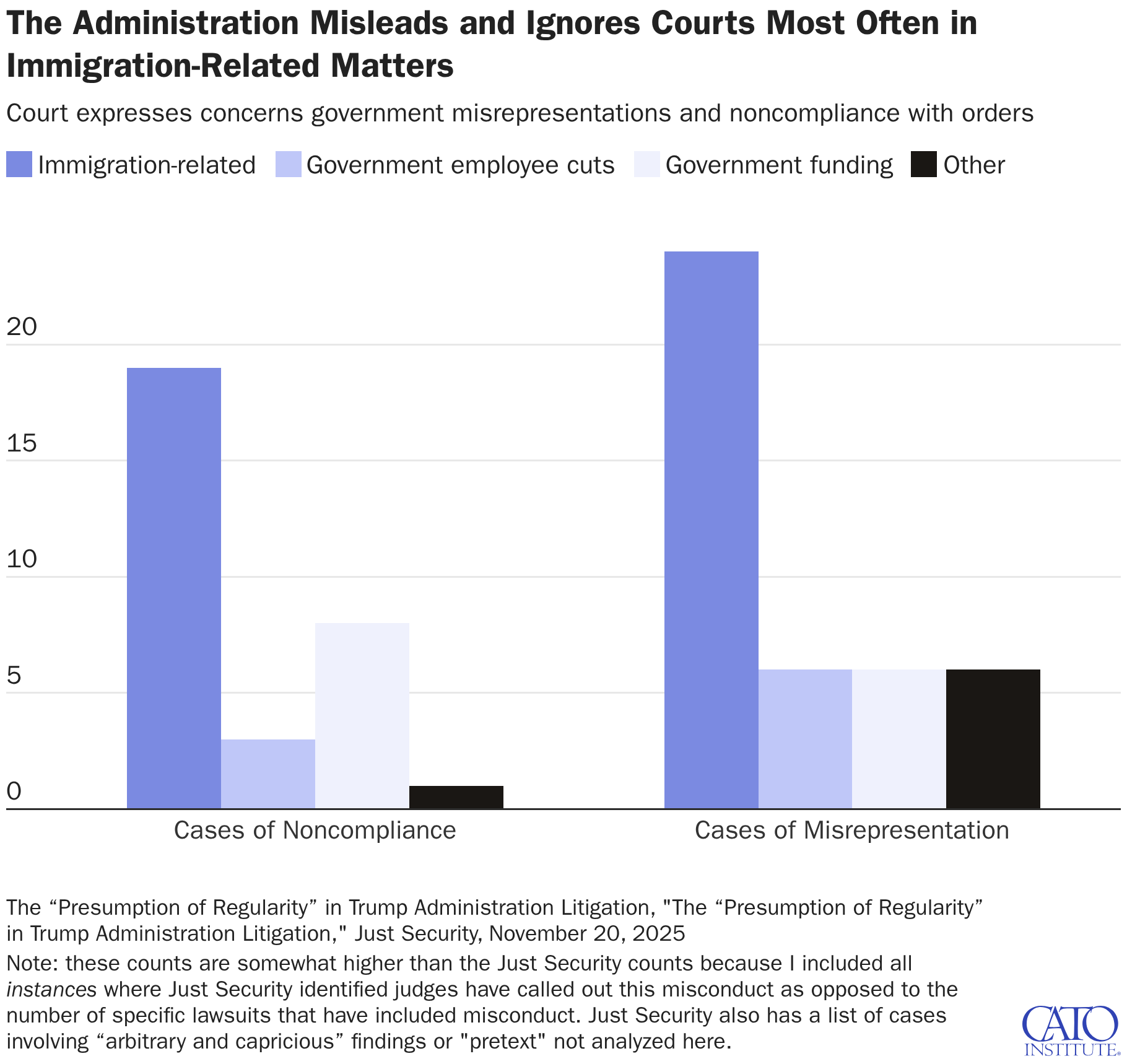
Authority-switching on tariffs is aggressive, but you can reasonably argue that it's how delegated power was designed to work. Claiming a freeze continues while rescinding the document that authorized it, however, is lawyerly bad faith. And the Washington Post's finding that the administration defied, delayed, or manipulated rulings in a full third of all adverse decisions, or the Cato Institute's documentation that immigration accounted for 57% of all cases where judges found the administration misled the court, that's something else entirely. You don't need to lie to judges if your authority-switching is legitimate. A DOJ official says he was fired for refusing to do exactly that.
Defiance is easy to see. When Andrew Jackson (apocryphally) said "John Marshall has made his decision, now let him enforce it," his words couldn't be interpreted as anything but a crisis because that kind of outright defiance immediately triggers the "code red" constitutional alarm bells.
Arbitrage, on the other hand, is almost invisible. In some ways it's more dangerous than outright defiance because it avoids altogether the direct confrontation that would force a response. This is where the "presidents have always clashed with courts" argument kind of falls apart.
Lincoln defied the judiciary on habeas corpus during an actual civil war. FDR tried to pack the court after adverse rulings within one policy domain during the Great Depression. But neither of them turned court-dodging into an all-purpose governance tool deployed across every major policy area at once. And neither of them did it in peacetime.
What we're watching now is the emergence of a sort of decorative judiciary. The courts keep issuing rulings. The news keeps calling them "major blows." And the next morning the policy is back under a different statute. The republic still has courts, but their rulings are increasingly cosmetic. Kind of like a constitutional Potemkin village. It has all the forms of judicial review, but without any of the substance. 663 lawsuits filed. 215 plaintiff wins. And an agenda that continues largely unimpeded. Instead of the losses actually being defeats, they're just the cost of doing business in a system where another statute is always available and reimposition is always faster than adjudication.
Let's return to where we started. Friday morning, February 20th, 2026. The Supreme Court says no, and by the same afternoon, the president just shrugs.
81% of Americans believe the administration must follow court orders (crazy idea, I know). So the problem isn't public will. The problem is that our constitutional system assumed good-faith compliance with the spirit of rulings instead of just the letter. The framers assumed that a president who tried to treat the law this way would be checked by the both the courts and Congress. But they didn't predict a Congress so morally bankrupt that it completely abdicated its power to stop such a would-be tyrant.
I've about stretched myself to the absolute limits of my knowledge of the law (which is abysmally slim to begin with), but I think the diagnosis here is "an administration that exploits gaps between overlapping statutory authorities faster than the judiciary can respond."
And in my opinion, the treatment needs to be a combination of statutory consolidation, mandatory compliance windows after adverse rulings, and (most importantly) Congressional reclamation of delegated powers that were never meant to be stacked as a judicial workaround.
Constitutional arbitrage has a name now. It admittedly can feel like small potatoes when compared to the rest of the destruction the second Trump administration has left in its wake. But assuming our liberal democracy holds, it's something Americans need to fix in order to further limit the tools a future would-be tyrant has at their disposal.

Thank you so much for reading! If you enjoy my work and want to support me further, one-time tips are always appreciated but never expected.